IPC vs BNS: Complete Section Mapping in Serial (IPC) Order

Cyber Law & Criminal Justice Reform · CYBER COPS India
IPC vs BNS: Complete Section Mapping
in Serial (IPC) Order
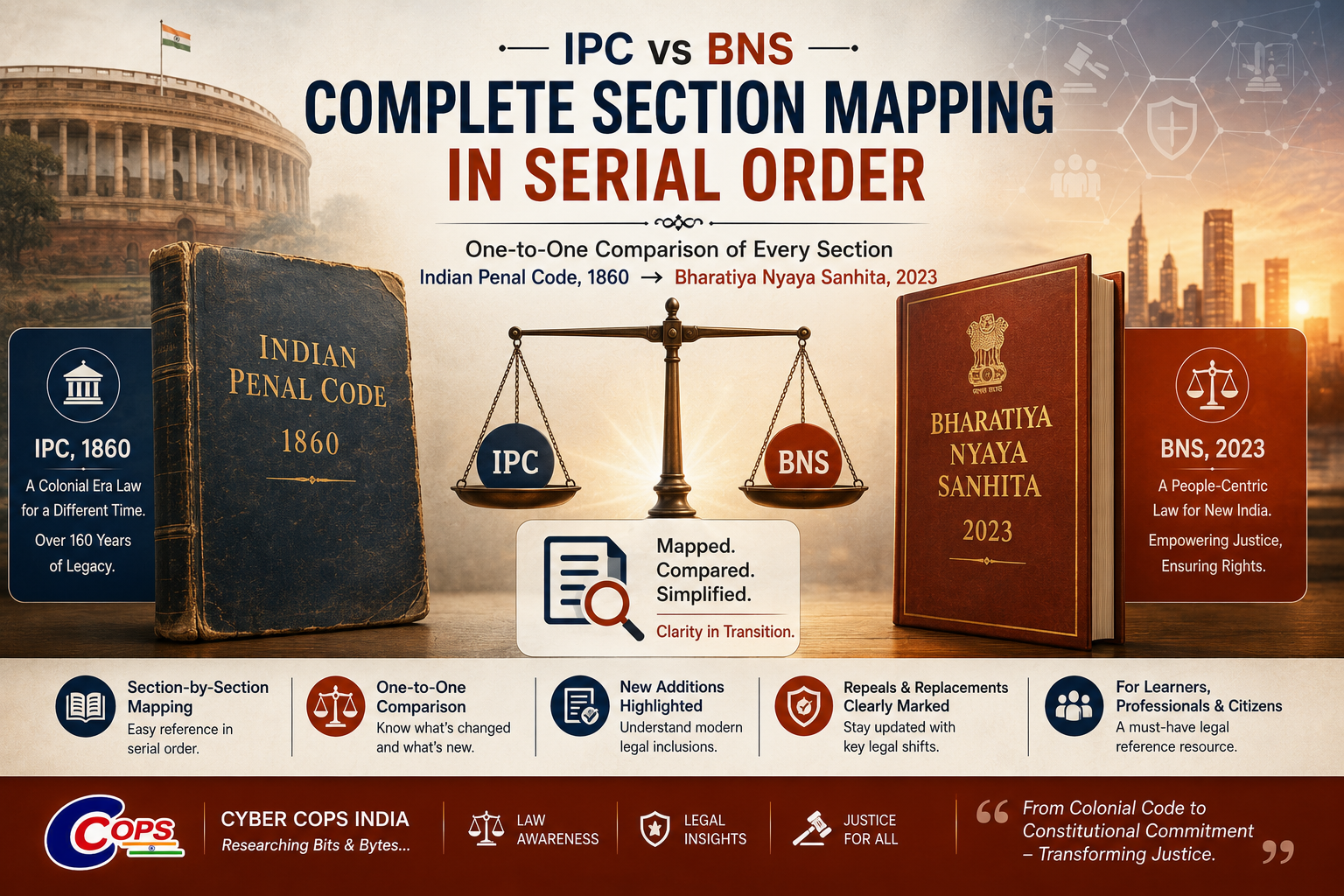
The Indian Penal Code, 1860 was repealed on 1 July 2024 and replaced by the Bharatiya Nyaya Sanhita (BNS), 2023. This article provides a verified, IPC-section-ordered mapping of all key provisions — from §34 to §509 — to their BNS equivalents, along with key changes, new sections, and omissions.
1. Background: Why IPC Was Replaced
For 163 years, India’s criminal justice system rested on a statute drafted under British colonial rule — the Indian Penal Code, 1860 (IPC). Enacted on 6 October 1860 and conceptualised by the first Law Commission of India under Lord Thomas Babington Macaulay, the IPC served as the bedrock of substantive criminal law, defining offences and prescribing punishments for everything from petty theft to murder and treason.
Despite hundreds of amendments over the decades, the IPC retained its colonial architecture, its language, its prioritisation of “offences against the State” over offences against citizens, and its fine structures that were outdated by orders of magnitude. The Parliament of India, in December 2023, passed three landmark statutes to replace the colonial criminal law framework entirely:
- Bharatiya Nyaya Sanhita (BNS), 2023 — replacing the IPC, 1860
- Bharatiya Nagarik Suraksha Sanhita (BNSS), 2023 — replacing the CrPC, 1973
- Bharatiya Sakshya Adhiniyam (BSA), 2023 — replacing the Indian Evidence Act, 1872
All three received Presidential assent and were notified in the Gazette of India (S.O. No. 810 & 811 dated 23–24 February 2024). They came into force simultaneously on 1 July 2024, with one exception: BNS Section 106(2) (hit-and-run with enhanced punishment) was deferred following protests by the transport sector.
2. Key Structural & Philosophical Shifts
Complete Renumbering — The Most Disorienting Change
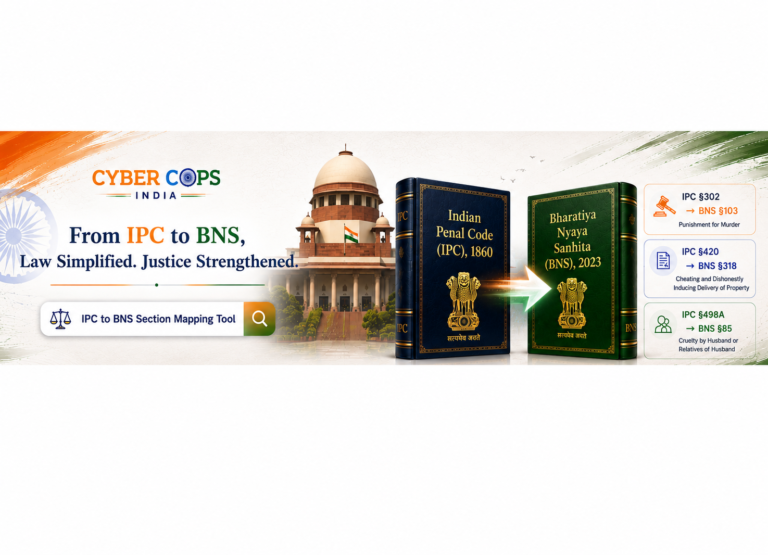
No IPC section number maps directly to the same BNS number. The renumbering is non-sequential and reflects a deliberate reorganisation of chapter priorities. The most consequential example: IPC §302 (murder) is now BNS §103. BNS §302 is an entirely different offence — it deals with “uttering words with deliberate intent to wound religious feelings,” which approximately corresponds to the old IPC §298. Citing BNS §302 in a murder charge sheet is a serious drafting error.
Chapter Priority Reversed
The IPC opened with “Offences against the State” (Chapter VI) before offences against the human body (Chapter XVI). The BNS reverses this priority — placing Offences against Women and Children in Chapter V and Offences affecting the Human Body in Chapter VI, before offences against the State. This reflects a citizen-centric orientation, a conscious departure from the colonial framework that prioritised the security of the empire.
Community Service Introduced
BNS Section 4 formally introduces community service as a permissible punishment for petty offences — the first time this rehabilitative measure has been codified in Indian substantive criminal law. It applies to offences like simple hurt (§115(2)), petty theft under ₹5,000 (§303(2)), public intoxication, and defamation.
Digital Offences Explicitly Recognised
Electronic records, digital communications, and cyber-enabled offences are now explicitly woven into the definitions across the BNS — including in forgery, defamation, stalking, voyeurism, and cheating provisions. Under the IPC, digital offences were largely addressed through the Information Technology Act, 2000, by way of a workaround. The BNS brings them within the penal code’s primary text.
Consolidation of Sections
The 511 IPC sections (including 64 inserted sections and 21 repealed by subsequent amendments, giving an effective count of ~535 operative sections) have been consolidated into 358 BNS sections. 249 IPC sections were reorganised within 62 BNS sections, and 286 IPC sections were carried forward as individual BNS sections. 10 new sections were added with no IPC precedent.
3. Most-Cited Sections — Quick Reference
These are the top conversions that every legal professional, police officer, and law student needs to know immediately.
4. General Provisions, Common Intention & Conspiracy
The foundational provisions of the IPC covering common intention, joint liability, abetment, and criminal conspiracy have been retained in the BNS with minimal substantive change. The principal change is their renumbering and, in the case of common intention, their repositioning as a sub-clause of the general explanations section (BNS §3).
| IPC Section | IPC Offence / Heading | BNS Section | Key Change / Remark |
|---|---|---|---|
| §34 | Acts done by several persons in furtherance of common intention | §3(5) | Retained as sub-clause of general explanations; concept unchanged; still the cornerstone of joint liability |
| §107 | Abetment of a thing | §45 | Definition retained; abetment by conspiracy, instigation, and intentional aid all preserved |
| §108 | Abettor | §45 | Merged with abetment definition |
| §109 | Punishment of abetment if the act abetted is committed | §48 | Retained; punishment mirrors principal offence |
| §120A | Definition of criminal conspiracy | §61 | Definition retained; placed earlier in the Code structure reflecting its foundational importance |
| §120B | Punishment of criminal conspiracy | §61 | Merged with §120A into BNS §61; punishment structure retained |
| §149 | Every member of unlawful assembly guilty of offence committed in prosecution of common object | §190 | Retained; constructive liability doctrine unchanged |
Source: BNS 2023 bare act; IPC 1860; cross-verified against MHA Gazette notification S.O. No. 810/811 (Feb 2024)
5. Offences Affecting the Human Body (IPC §299 – §338)
This is the category most disorienting for practitioners because the BNS numbers bear no sequential relationship to the old IPC numbers. Murder (IPC §302) is now BNS §103. The cluster of hurt provisions (§323, §324, §325, §326) maps to BNS §115, §118, §117, §119 — not in the same relative order. Careful attention to individual section numbers is essential.
| IPC Section | IPC Offence / Heading | BNS Section | Key Change / Remark |
|---|---|---|---|
| §299 | Culpable homicide (definition) | §100 | Definition retained without material change |
| §300 | Murder (definition) | §101 | Definition and exceptions retained |
| §302 | Punishment for murder | §103(1) | Death or life imprisonment + fine retained; §103(2) adds NEW mob lynching aggravation — death/life, minimum 7 yrs |
| §303 | Punishment for murder by life-convict | §104 | Death punishment for murder by a person under sentence of life imprisonment; retained |
| §304 | Punishment for culpable homicide not amounting to murder | §105 | Part I (intention) and Part II (knowledge) distinction retained; punishment unchanged |
| §304A | Causing death by negligence | §106 | CHANGED §106(2) adds enhanced punishment of up to 10 yrs if offender escapes without reporting to police (hit-and-run); this sub-section deferred initially |
| §304B | Dowry death | §80 | Moved to Chapter V (Offences against Women); definition and presumption clause unchanged; min 7 yrs retained |
| §305 | Abetment of suicide of child or insane person | §107 | Retained; death/life or up to 10 yrs punishment retained |
| §306 | Abetment of suicide | §108 | Retained; up to 10 yrs + fine; SC tests of “active instigation” continue to apply |
| §307 | Attempt to murder | §109 | Retained; punishment unchanged — up to 10 yrs or life imprisonment (if hurt caused) + fine |
| §308 | Attempt to commit culpable homicide | §110 | Retained; up to 3 yrs or fine or both |
| §309 | Attempt to commit suicide | §226 | Retained but read alongside Mental Healthcare Act 2017 §115, which limits prosecution of persons in mental health crisis |
| §319 | Hurt (definition) | §114 | Definition retained |
| §320 | Grievous hurt (definition) | §116 | Definition retained; eight enumerated categories of grievous hurt preserved |
| §321 | Voluntarily causing hurt (definition) | §115(1) | Definition retained |
| §323 | Punishment for voluntarily causing hurt | §115(2) | CHANGED Community service added as an alternative punishment for the first time in Indian penal law; also up to 1 yr / ₹10,000 / both |
| §324 | Voluntarily causing hurt by dangerous weapons or means | §118 | Retained; fire and heated substances now explicitly mentioned; up to 3 yrs / fine / both |
| §325 | Punishment for voluntarily causing grievous hurt | §117 | Retained; up to 7 yrs + fine |
| §326 | Voluntarily causing grievous hurt by dangerous weapons | §119 | Retained; life / up to 10 yrs + fine; acid attack carved out to a separate section |
| §326A | Voluntarily causing grievous hurt by use of acid etc. | §124 | CHANGED Dedicated acid attack section; minimum 10 yrs up to life + fine (minimum ₹10 lakh payable to victim) |
| §326B | Voluntarily throwing or attempting to throw acid | §124 | Merged into §124; minimum 5 yrs up to 7 yrs + fine |
| §332 | Voluntarily causing hurt to deter public servant | §121 | Retained; up to 3 yrs / fine / both |
| §333 | Voluntarily causing grievous hurt to deter public servant | §121 | Retained; up to 10 yrs + fine |
| §336 | Act endangering life or personal safety of others | §125 | Retained; up to 3 months / ₹250 / both |
| §337 | Causing hurt by act endangering life | §125(a) | Retained as sub-clause |
| §338 | Causing grievous hurt by act endangering life | §125(b) | Retained as sub-clause |
| §339 | Wrongful restraint | §126(1) | Definition retained |
| §340 | Wrongful confinement | §127(1) | Definition retained |
| §341 | Punishment for wrongful restraint | §126(2) | Retained as sub-clause; up to 1 month / ₹500 / both |
| §342 | Punishment for wrongful confinement | §127(2) | Retained as sub-clause; up to 1 yr / ₹1,000 / both |
| §351 | Assault (definition) | §130(1) | Definition retained |
| §352 | Punishment for assault or criminal force otherwise than on grave provocation | §131 | Retained; up to 3 months / ₹500 / both |
| §353 | Assault or criminal force to deter public servant | §132 | Retained; up to 2 yrs / fine / both |
Source: BNS 2023 bare act; Vakeel360 IPC-BNS Converter; Lawsikho conversion table (2026); Jurigram IPC-BNS guide (Feb 2026)
6. Offences Against Women & Children (IPC §354 – §509 cluster)
The BNS consolidates gender-based offences into Chapter V (Sections 63–98), grouping provisions that were scattered across different IPC chapters. This represents one of the most thoughtful structural improvements in the BNS — a practitioner handling a dowry harassment matter can now find all related provisions within the same chapter, rather than navigating across IPC Chapters XIV, XVI, and XX.
| IPC Section | IPC Offence / Heading | BNS Section | Key Change / Remark |
|---|---|---|---|
| §354 | Assault or criminal force to woman with intent to outrage her modesty | §74 | Retained; minimum 1 yr, maximum 5 yrs + fine; grouped with related gender offences |
| §354A | Sexual harassment and punishment for sexual harassment | §75 | Retained; three-tier punishment structure (up to 3 yrs / up to 1 yr / fine) preserved; operates alongside POSH Act 2013 |
| §354B | Assault or use of criminal force to woman with intent to disrobe | §76 | Retained; minimum 3 yrs, maximum 7 yrs + fine |
| §354C | Voyeurism | §77 | Retained; digital/electronic voyeurism explicitly covered; 1st offence: 1–3 yrs; 2nd: 3–7 yrs + fine |
| §354D | Stalking | §78 | Retained; cyber-stalking and electronic monitoring explicitly included; 1st: up to 3 yrs; repeat: up to 5 yrs |
| §359–§361 | Kidnapping (definitions) | §137 | Definitions consolidated; kidnapping from India and from lawful guardianship both retained |
| §362 | Abduction | §138 | Definition retained |
| §363 | Punishment for kidnapping | §137(2) | Merged into §137; up to 7 yrs + fine retained |
| §364 | Kidnapping or abducting in order to murder | §140 | Retained; life / up to 10 yrs + fine |
| §364A | Kidnapping for ransom, etc. | §140(2) | Retained; death / life + fine |
| §366 | Kidnapping, abducting or inducing woman to compel her marriage | §87 | Retained; up to 10 yrs + fine |
| §370 | Trafficking of person | §143 | CHANGED Strengthened; minimum 7 yrs up to life (aggravated trafficking); BNS expands the anti-trafficking framework |
| §375 | Rape (definition) | §63 | Definition largely mirrors IPC §375; marital rape exception retained with minor language update; seven categories of deemed consent expanded |
| §376 | Punishment for rape | §64 | Retained; minimum 10 yrs rigorous imprisonment up to life + fine; gang rape under §70 |
| §376A | Punishment for causing death or resulting in persistent vegetative state of victim | §66 | Retained; minimum 20 yrs RI extendable to life (remainder of natural life) or death |
| §376AB | Punishment for rape of woman under 12 years | §65 | Retained; minimum 20 yrs up to life / death + fine (minimum ₹10 lakh) |
| §376D | Gang rape | §70 | CHANGED Enhanced; minimum 20 yrs up to life + fine (minimum ₹10 lakh); rape of minor under 16 and 12 consolidated here with mandatory life / death |
| §376E | Punishment for repeat offenders | §71 | Retained; life imprisonment / death for repeat sexual offenders |
| §493 | Cohabitation caused by a man deceitfully inducing a belief of lawful marriage | §81 | Retained; up to 10 yrs + fine |
| §494 | Marrying again during the lifetime of husband or wife (bigamy) | §82 | Retained; up to 7 yrs + fine |
| §495 | Same offence with concealment of former marriage | §82 | Merged into §82; up to 10 yrs + fine |
| §496 | Marriage ceremony fraudulently gone through without lawful marriage | §83 | Retained; up to 7 yrs + fine |
| §497 | Adultery | OMITTED DEL | Struck down as unconstitutional by SC in Joseph Shine v. Union of India (2018); correctly omitted from BNS |
| §498 | Enticing or taking away or detaining with criminal intent a married woman | §84 | Retained; up to 2 yrs / fine / both |
| §498A | Husband or relative of husband of a woman subjecting her to cruelty | §85 | Retained; up to 3 yrs + fine; one of the most litigated sections in India; Arnesh Kumar guidelines continue to apply |
| §509 | Word, gesture or act intended to insult the modesty of a woman | §79 | CHANGED Punishment enhanced from 1 yr to up to 3 yrs + fine; now grouped with other gender-based offences |
Source: BNS 2023 bare act; Vakeel360; Lawsikho; Jurigram. All section references cross-verified.
7. Offences Against Property (IPC §378 – §462)
Property offences constitute the largest share of the criminal docket in district courts across India. The BNS has carried over the substantive definitions with minimal change but has significantly renumbered them. The most culturally embedded number in Indian criminal law, Section 420 (synonymous with “cheater” in everyday language), is now BNS §318.
| IPC Section | IPC Offence / Heading | BNS Section | Key Change / Remark |
|---|---|---|---|
| §378 | Theft (definition) | §303(1) | Definition retained |
| §379 | Punishment for theft | §303(2) | Up to 3 yrs / fine / both retained; petty theft under ₹5,000 now eligible for community service |
| §380 | Theft in dwelling house, etc. | §305 | Retained; up to 7 yrs + fine |
| §381 | Theft by clerk or servant of property in possession of master | §306 | Retained; up to 7 yrs + fine |
| §382 | Theft after preparation made for causing death, hurt, or restraint | §307 | Retained; up to 10 yrs + fine |
| §383 | Extortion (definition) | §308(1) | Definition retained |
| §384 | Punishment for extortion | §308(2) | Retained; up to 3 yrs / fine / both |
| §385 | Putting person in fear of injury in order to commit extortion | §309 | Retained; up to 2 yrs / fine / both |
| §386 | Extortion by putting person in fear of death or grievous hurt | §310(1) | Retained; up to 10 yrs + fine |
| §390 | Robbery (definition) | §309(1) | Definition retained; distinction from dacoity (5+ persons) maintained |
| §391 | Dacoity (definition) | §310(1) | Definition retained; five or more persons threshold maintained |
| §392 | Punishment for robbery | §309(2) | Retained; up to 10 yrs + fine; road robbery: up to 14 yrs |
| §395 | Punishment for dacoity | §310(2) | Retained; life / up to 10 yrs + fine |
| §396 | Dacoity with murder | §311 | Retained; death / life + fine |
| §397 | Robbery or dacoity with attempt to cause death or grievous hurt | §312 | Retained; minimum 7 yrs |
| §403 | Dishonest misappropriation of property | §314 | Retained; up to 2 yrs / fine / both |
| §405 | Criminal breach of trust (definition) | §316(1) | Definition retained; entrustment element required |
| §406 | Punishment for criminal breach of trust | §316(2) | Retained; up to 3 yrs / fine / both; frequently cited in corporate and white-collar matters |
| §407 | Criminal breach of trust by carrier, wharfinger or warehouse-keeper | §317 | Retained; up to 7 yrs + fine |
| §408 | Criminal breach of trust by clerk or servant | §317 | Merged with §407 equivalent in BNS; up to 7 yrs + fine |
| §409 | Criminal breach of trust by public servant, banker, merchant, etc. | §317 | Retained; life / up to 10 yrs + fine |
| §411 | Dishonestly receiving stolen property | §317 | Retained; up to 3 yrs / fine / both |
| §415 | Cheating (definition) | §318(1) | Definition retained; digital fraud and online deception now explicitly covered within scope |
| §416 | Cheating by personation | §319 | Retained; identity fraud and online personation covered; up to 3 yrs / fine / both |
| §417 | Punishment for cheating | §318(2) | Retained; up to 1 yr / fine / both |
| §418 | Cheating with knowledge that wrongful loss may ensue to a person whose interest the offender is bound to protect | §318(3) | Retained; up to 3 yrs / fine / both |
| §419 | Punishment for cheating by personation | §319(2) | Merged with definition; up to 3 yrs / fine / both |
| §420 | Cheating and dishonestly inducing delivery of property | §318(4) | Retained; up to 7 yrs + fine; the most commonly cited cheating provision; “420” as colloquial term for fraudster now refers to BNS §318(4) |
| §425 | Mischief (definition) | §324 | Retained; damage to digital property under discussion; provision text updated |
| §427 | Mischief causing damage to the amount of ₹50 | §324 | CHANGED Archaic ₹50 threshold removed; modernised |
| §435 | Mischief by fire or explosive substance with intent to cause damage | §326 | Retained; up to 7 yrs / life (if cause specified) + fine |
| §441 | Criminal trespass (definition) | §329(1) | Definition retained |
| §442 | House-trespass | §330 | Retained; up to 1 yr / ₹1,000 / both |
| §445 | House-breaking | §331 | Retained; up to 2 yrs / fine / both |
| §447 | Punishment for criminal trespass | §329(2) | Retained; up to 3 months / ₹500 / both |
| §452 | House-trespass after preparation for hurt, assault, or wrongful restraint | §333 | Retained; up to 7 yrs + fine |
| §454 | Lurking house-trespass or house-breaking in order to commit offence punishable with imprisonment | §332 | Retained; up to 3 yrs + fine |
Source: BNS 2023 bare act; Vakeel360; Lawsikho (2026); Jurigram (Feb 2026)
8. Offences Against the State & Public Tranquility (IPC §121 – §160)
This category has undergone the most significant substantive changes in the IPC-to-BNS transition. The most watched change is the treatment of sedition — the colonial-era IPC §124A has been replaced not by a direct re-enactment but by a differently worded provision focused on acts endangering sovereignty, unity, and integrity of India.
| IPC Section | IPC Offence / Heading | BNS Section | Key Change / Remark |
|---|---|---|---|
| §121 | Waging, or attempting to wage war, or abetting waging of war, against the Government of India | §147 | Retained; death / life + fine; most serious offence against the State |
| §121A | Conspiracy to commit offences punishable by §121 | §148 | Retained; life / up to 10 yrs + fine |
| §122 | Collecting arms, etc., with intention of waging war | §149 | Retained; life / up to 10 yrs + fine |
| §123 | Concealing with intent to facilitate design to wage war | §149 | Merged with §122 equivalent; up to 10 yrs + fine |
| §124A | Sedition | §152 CHANGED | “Sedition” word removed; replaced by “Acts endangering sovereignty, unity and integrity of India”; requires armed rebellion / separatist activity; up to 7 yrs or life imprisonment; textually narrower than §124A |
| §141 | Unlawful assembly (definition) | §187 | Definition retained; 5-person threshold maintained |
| §143 | Punishment for being a member of an unlawful assembly | §189 | Retained; up to 6 months / ₹1,000 / both |
| §144 | Joining unlawful assembly armed with deadly weapon | §189 | Merged; up to 2 yrs / fine / both |
| §146 | Rioting (definition) | §191(1) | Definition retained |
| §147 | Punishment for rioting | §191(2) | Retained; up to 2 yrs / fine / both |
| §148 | Rioting, armed with deadly weapon | §191(3) | Retained; up to 3 yrs / fine / both |
| §149 | Every member of unlawful assembly guilty of offence (constructive liability) | §190 | Retained; constructive liability doctrine intact |
| §153A | Promoting enmity between different groups on grounds of religion, race, etc. | §196 | Retained; electronic and digital promotion of enmity now explicitly covered; up to 3 yrs / 5 yrs (if in place of worship) + fine |
| §153B | Imputations, assertions prejudicial to national integration | §197 | Retained; up to 3 yrs / fine / both |
Source: BNS 2023 bare act; Jurigram IPC-BNS Guide (Feb 2026); Lawsikho (2026); SC order placing §124A on hold (May 2022)
9. Offences by / Relating to Public Servants & Contempt of Authority
| IPC Section | IPC Offence / Heading | BNS Section | Key Change / Remark |
|---|---|---|---|
| §166 | Public servant disobeying law, with intent to cause injury to any person | §202(1) | Retained; up to 1 yr / fine / both |
| §166A | Public servant disobeying direction under law | §202(2) | Retained; failure to register FIR: min 6 months up to 2 yrs + fine |
| §166B | Punishment for non-treatment of victim | §202(3) | Merged into §202; up to 1 yr / fine / both |
| §167 | Public servant framing an incorrect document with intent to cause injury | §210 | Retained; up to 3 yrs / fine / both |
| §172 | Absconding to avoid service of summons or other proceeding | §206 | Retained; up to 1 month / ₹500 / both |
| §175 | Omission to produce document to public servant by person legally bound to produce it | §209 | Retained; electronic records explicitly included; up to 1 month / ₹500 / both |
| §176 | Omission to give notice or information to public servant | §211 | Retained; up to 1 month / ₹500 / both |
| §177 | Furnishing false information | §215 | Retained; up to 6 months / ₹1,000 / both |
| §182 | False information, with intent to cause public servant to use his lawful power | §217 | Retained; up to 6 months / ₹1,000 / both |
| §186 | Obstructing public servant in discharge of public functions | §221 | Retained; up to 3 months / ₹2,500 / both |
| §187 | Omission to assist public servant when bound by law to give assistance | §222 | Retained; up to 1 month / ₹200 / both |
| §188 | Disobedience to order duly promulgated by public servant | §223 | Retained; up to 1 month / ₹200; 6 months / ₹1,000 if danger caused |
| §191 | Giving false evidence (definition) | §227 | Retained; electronic records and digital evidence explicitly included |
| §193 | Punishment for false evidence | §229 | Retained; up to 7 yrs + fine |
| §194 | Giving or fabricating false evidence with intent to procure conviction of capital offence | §230 | Retained; life / up to 10 yrs + fine |
| §201 | Causing disappearance of evidence of offence, or giving false information to screen offender | §238 | Retained; electronic records explicitly included; punishment varies with principal offence |
| §211 | False charge of offence made with intent to injure | §248 | Retained; up to 2 yrs / 7 yrs (if capital / life offence falsely charged) + fine |
Source: BNS 2023 bare act; cross-verified against Jurigram (Feb 2026) and Vakeel360
10. Offences Relating to Documents & Property Marks (IPC §463 – §489)
The BNS has modernised the forgery chapter by explicitly recognising electronic records and digital documents throughout. Under the IPC, digital documents were addressed through the IT Act 2000 by a legal fiction; under the BNS, they are part of the primary text of the penal code.
| IPC Section | IPC Offence / Heading | BNS Section | Key Change / Remark |
|---|---|---|---|
| §463 | Forgery (definition) | §336(1) | Definition retained; making a false document/electronic record with intent; digital documents explicitly covered |
| §464 | Making a false document | §336 | Merged into definition; electronic records included |
| §465 | Punishment for forgery | §336(3) | Retained; up to 2 yrs / fine / both |
| §467 | Forgery of valuable security, will, etc. | §338 | Retained; life / up to 10 yrs + fine; one of the most serious forgery offences |
| §468 | Forgery for purpose of cheating | §339 | Retained; up to 7 yrs + fine; electronic forgery explicitly covered |
| §469 | Forgery for purpose of harming the reputation of any person | §340 | Retained; online reputation harm and digital defamation by forgery now explicitly covered; up to 3 yrs + fine |
| §471 | Using as genuine a forged document | §341 | Retained; same punishment as for forgery of such document |
| §472 | Making or possessing counterfeit seal, plate, etc. | §342 | Retained; up to 7 yrs + fine |
| §474 | Having possession of document described in §466 or §467 | §344 | Retained; life / up to 7 yrs + fine |
Source: BNS 2023 bare act; Jurigram (Feb 2026)
11. Defamation, Criminal Intimidation & Speech Offences (IPC §499 – §509)
| IPC Section | IPC Offence / Heading | BNS Section | Key Change / Remark |
|---|---|---|---|
| §499 | Defamation (definition) | §356(1) | CHANGED Online and digital defamation now explicitly covered; remains a criminal offence; community service added as punishment option |
| §500 | Punishment for defamation | §356(2) | Retained; up to 2 yrs / fine / both; community service added as alternative |
| §501 | Printing or engraving matter known to be defamatory | §357 | Retained; up to 2 yrs / fine / both; digital publication covered |
| §503 | Criminal intimidation (definition) | §351(1) | Definition retained; online and anonymous cyber threats explicitly covered |
| §504 | Intentional insult with intent to provoke breach of the peace | §352 | Retained; up to 2 yrs / fine / both |
| §505 | Statements conducing to public mischief | §353 | CHANGED Electronic publication of false or alarming statements now explicitly covered; includes misinformation; up to 3 yrs / fine / both |
| §506 | Punishment for criminal intimidation | §351(2) | Retained; up to 2 yrs / 7 yrs (if death threat) + fine; often tagged with §115(2) BNS in assault FIRs |
| §507 | Criminal intimidation by an anonymous communication | §351(3) | Retained; additional 2 yrs for anonymous threats; covers anonymous online messages and emails |
Source: BNS 2023 bare act; Vakeel360; Jurigram (Feb 2026)
12. New Offences in BNS with No Direct IPC Equivalent
The BNS introduced 10 new offences that have no direct equivalent in the IPC. These represent the most significant legislative additions — areas where the IPC was either silent or dependent on special statutes. Understanding these new provisions is critical for legal professionals as they will generate the most complex litigation in the coming decade.
| BNS Section | New Offence | Prior IPC Status | Punishment & Significance |
|---|---|---|---|
| §69 NEW | Sexual intercourse by deceitful means or false promise of marriage | No direct IPC equivalent; addressed under §375 by judicial interpretation of consent | Up to 10 yrs + fine; codifies the SC jurisprudence distinguishing “breach of promise” from “false promise from inception”; widely litigated already |
| §103(2) NEW | Mob lynching (murder by group of 5+ on grounds of race, caste, sex, religion, etc.) | No IPC equivalent; addressed through general §302 / §149 | Death / life + fine; minimum 7 yrs; specifically named in the statute — a landmark recognition |
| §111 NEW | Organised crime (syndicate-based criminal activities) | No national IPC equivalent; state-specific laws (MCOCA, GUJCOCA) applied | Life / death + fine (minimum ₹10 lakh); covers kidnapping, extortion, robbery, cyber-crime, economic offences by syndicates; drastically limits bail eligibility |
| §112 NEW | Petty organised crime (pickpocketing, snatching, card fraud, etc. by groups) | Addressed through §379 / §392; no distinct provision | Up to 1 yr / fine / both; community service possible |
| §113 NEW | Terrorist acts | Covered under UAPA (Unlawful Activities Prevention Act); not in IPC | Death / life + fine; terrorism now in the general penal code for the first time; acts causing terror, threatening security of India |
| §152 REPLACED | Acts endangering sovereignty, unity and integrity of India (replaces Sedition §124A) | IPC §124A (Sedition) — SC put on hold in 2022 | Up to 7 yrs or life + fine; requires element of armed rebellion / separatist activity; textually narrower than old sedition law |
| §303(2) NEW | Snatching (newly codified distinct offence) | Addressed through §379 or §392; no distinct provision | Up to 3 yrs / fine / both; targets chain-snatching, mobile phone theft by sudden force; fills the gap between simple theft and robbery |
Source: BNS 2023 bare act; Jurigram (Feb 2026); Lawsikho (2026); Vakeel360
13. IPC Provisions Omitted / Deleted in BNS
19 colonial provisions have been omitted from the BNS. Three of the most significant omissions reflect landmark Supreme Court judgments that had already rendered those provisions partially or wholly inoperative.
| IPC Section | IPC Offence | Reason for Omission |
|---|---|---|
| §310 | Thug (definition) | Omitted as archaic colonial provision with no modern relevance |
| §311 | Punishment of a Thug | Omitted with §310 |
| §377 | Unnatural offences | Struck down as unconstitutional regarding consensual adult acts — Navtej Singh Johar & Ors. v. Union of India (2018, SC Constitution Bench); correctly omitted from BNS. Note: non-consensual acts are addressed under other BNS sexual assault provisions |
| §497 | Adultery | Struck down as unconstitutional — Joseph Shine v. Union of India (2018, SC Constitution Bench); treated women as husband’s property; correctly omitted |
| §124A | Sedition | Not directly omitted but functionally replaced by BNS §152 with narrower scope; SC had placed it on hold in May 2022; term “sedition” does not appear in BNS |
Source: BNS 2023 bare act; Navtej Singh Johar v. UOI (2018); Joseph Shine v. UOI (2018); Jurigram (Feb 2026)
14. Transition Rules: Which Law Applies?
The transition from IPC to BNS has created a dual-track legal system that will operate in parallel for years. Understanding the governing rule is non-negotiable for every practitioner.
The Fundamental Rule (BNSS §531)
The date of the occurrence of the offence determines which substantive law applies — permanently. An offence committed on or before 30 June 2024 is governed by the IPC for the duration of its investigation and trial, even if proceedings extend years into the future.
| Scenario | Substantive Law | Procedural Law |
|---|---|---|
| Offence committed on or before 30 June 2024 | IPC 1860 | BNSS 2023 (for procedural steps after 1 Jul 2024) |
| Offence committed on or after 1 July 2024 | BNS 2023 | BNSS 2023 |
| Continuing offence spanning June–July 2024 (e.g., dowry cruelty) | Both IPC and BNS may be cited; police practice settling towards dual citation | BNSS 2023 |
| Bail application for an old (pre-July 2024) FIR | Substantive offence: IPC | Bail provisions: BNSS §483 (not CrPC §439) |
| High Court quashing petition for old IPC case | IPC | BNSS §528 (formerly CrPC §482); old SC judgments on IPC provisions remain applicable; petition must correlate old IPC section with new BNS equivalent |
Companion Legislations — The Three-Code Reform
Three colonial statutes were simultaneously replaced on 1 July 2024:
| Old Law | New Law | Sections |
|---|---|---|
| Indian Penal Code, 1860 (IPC) | Bharatiya Nyaya Sanhita, 2023 (BNS) | 511 → 358 |
| Code of Criminal Procedure, 1973 (CrPC) | Bharatiya Nagarik Suraksha Sanhita, 2023 (BNSS) | 484 → 531 |
| Indian Evidence Act, 1872 (IEA) | Bharatiya Sakshya Adhiniyam, 2023 (BSA) | 167 → 170 |
Key Takeaways for Legal Professionals & Citizens
- IPC §302 (Murder) = BNS §103 — never BNS §302. Print this on your chamber wall.
- IPC §420 (Cheating) = BNS §318(4). The number “420” is culturally embedded; legally, it is now §318.
- IPC §498A (Cruelty by husband) = BNS §85. Arnesh Kumar guidelines continue to apply.
- IPC §124A (Sedition) is replaced — not identically re-enacted — by BNS §152.
- New BNS provisions on organised crime (§111), terrorism (§113), and mob lynching (§103(2)) have no IPC precedent and will define complex criminal litigation for years.
- Old Supreme Court judgments interpreting IPC provisions remain applicable under BNS where the ingredients of the offence have not materially changed.
- Community service (BNS §4) is now a formal punishment — a first in Indian penal law.