IPC ↔ BNS Section Finder Complete User Guide

Legal Awareness & Criminal Law Reform · CYBER COPS India · July 2026
IPC ↔ BNS Section Finder
Complete User Guide
How to use every feature of India’s first free interactive criminal law reference tool — for citizens, lawyers, law students, and police personnel navigating the IPC to BNS transition.
Free · No Login · Works on Mobile · cybercops.in/ipc-bns-finder/
1. The Law Changed — Did You Know?
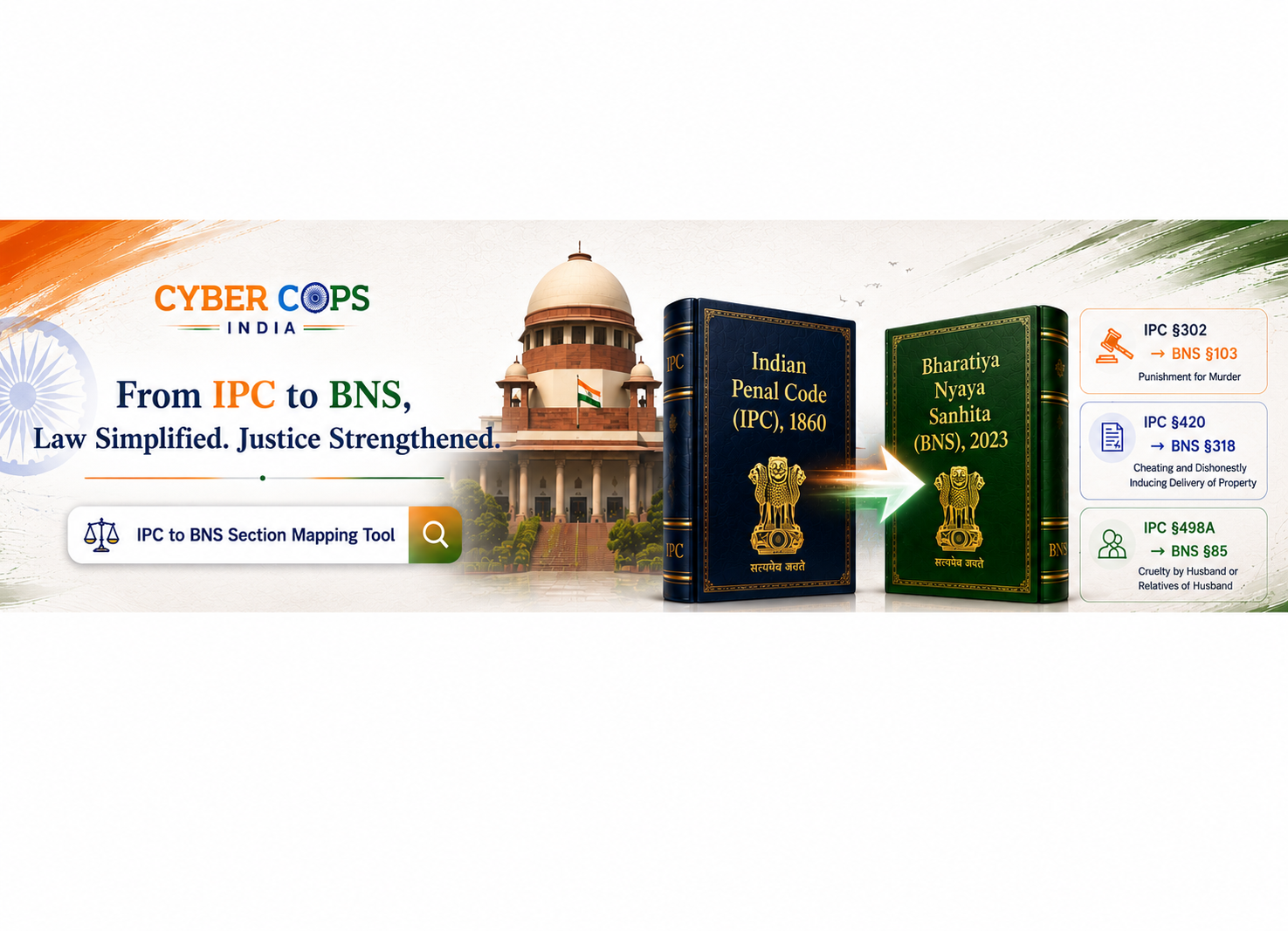
On 1 July 2024, the Indian Penal Code, 1860 — a statute that governed Indian criminal law for 163 years — was formally repealed and replaced by the Bharatiya Nyaya Sanhita (BNS), 2023. This was not a minor amendment. The entire structure of substantive criminal law was rewritten, renumbered, and reorganised.
The most disorienting consequence for practitioners, police, and citizens alike is that not a single IPC section number survived. The provision that every Indian knew as Section 302 — murder — is now Section 103. The provision colloquially synonymous with fraud — Section 420 — is now Section 318(4). The most litigated provision in district courts across India — Section 498A on cruelty by husband — is now Section 85.
The transition created an immediate practical problem. Courts began returning charge sheets citing wrong sections. Police officers filed FIRs under repealed provisions. Families of accused persons received documents they could not interpret. Law students preparing for exams found their section-number memory rendered obsolete overnight.
2. What the Tool Is
The IPC ↔ BNS Section Finder is a free standalone interactive tool hosted at cybercops.in/ipc-bns-finder/. It requires no login, no registration, and no payment. It works on any mobile phone, tablet, or desktop browser. It is built and maintained by CYBER COPS India, verified against the BNS 2023 bare act (Act 45 of 2023) as notified in the Gazette of India, and updated in phases as new features are added.
The tool currently maps 143 provisions — covering offences against human body, property, state, women and children, public tranquility, public servants, documents and electronic records, defamation and speech, General Exceptions, new BNS provisions with no IPC equivalent, and sections omitted from BNS following Supreme Court judgments.
3. Feature 1 — Search by IPC Section Number
If you know the old IPC section number and want to find where it now sits in the BNS, use the first search box labelled Search by IPC Section.
Type any IPC section number — e.g. 302, 420, 498A, 376, 304A, 120B — and press Enter or click Find
The tool instantly shows you the corresponding BNS section, what it covers, the punishment range under the BNS, and the bail status. Below the search box you will see clickable hint pills — 302 · 420 · 498A · 376 · 304A · 120B — which trigger the search with one tap. These are the most frequently searched IPC sections.
4. Feature 2 — Search by BNS Section Number
If you have received a charge sheet or FIR dated after 1 July 2024 and it cites a BNS section number you do not recognise, use the second search box labelled Search by BNS Section.
Type any BNS section number — e.g. 103, 318, 85, 63, 111, 152 — to trace it back to the original IPC provision
The tool shows you which IPC provision it replaced, what it covers, and the full details — punishment, bail status, and key changes from the IPC original.
5. Feature 3 — Search by Keyword
This is the most powerful search mode for anyone who does not know section numbers. Use the third search box and type any word describing the offence or topic.
Try: murder · rape · dowry · cheating · forgery · stalking · acid · terrorism · bail · non-bailable · community service
Every provision where that keyword appears — in the section title, the offence description, the punishment, or the key change column — appears in one flat table. The keyword search also works in Hindi when हि mode is active.
6. Feature 4 — Punishment Ranges
Every section in the tool shows the punishment range under BNS — the current applicable punishment. This includes:
- Minimum sentence where prescribed — shown in amber
- Maximum sentence — the ceiling a court may impose
- Fine amounts — including specific rupee figures where BNS prescribes them
- Death penalty provisions — highlighted in red (BNS §103, §396, §364A and others)
- Life imprisonment — shown in bold
- Community service — flagged where BNS explicitly provides for it as an alternative
7. Feature 5 — Bail Status
Every section shows whether the offence is Bailable or Non-Bailable — sourced from the First Schedule of the Bharatiya Nagarik Suraksha Sanhita (BNSS) 2023.
Bail can only be granted by a court. The police cannot grant bail at the station. Applies to murder, rape, dacoity, terrorism, organised crime, and many other serious offences.
Bail can be granted at the police station itself. The accused does not need to approach a court. Applies to minor hurt, simple defamation, simple trespass, and similar provisions.
Each section also shows whether the offence is Cognizable — police can arrest without a warrant — or Non-Cognizable — a warrant is required before arrest.
8. Feature 6 — Seven Instant Filters
Above the results table, seven filter buttons allow you to narrow the entire dataset with one click:
What each filter shows
- All Sections — returns to the full category-grouped view of all 143 sections
- Non-Bailable — only sections where bail requires court intervention. Useful for lawyers assessing which charges in a multi-section FIR are bail-restricting
- Bailable — only sections where bail can be obtained at the police station
- Community Service Available — all sections where BNS provides community service as an alternative to imprisonment
- New in BNS — the 10 provisions that have no IPC equivalent, including mob lynching (§103(2)), organised crime (§111), terrorism (§113), sexual intercourse by false promise of marriage (§69), and snatching (§303(2))
- Changed — all sections where BNS made a material change from IPC — enhanced punishment, expanded scope, new sub-sections
- Omitted — the three IPC provisions not carried forward into BNS: §310 (Thug — archaic colonial provision), §377 (struck down — Navtej Singh Johar v. Union of India, 2018), and §497 (struck down — Joseph Shine v. Union of India, 2018)
9. Feature 7 — Hindi Language Toggle
The tool supports full Hindi language display with a single click on the हि button in the language bar at the top of the page.
In Hindi mode, every section shows three layers simultaneously:
- English title — retained for reference
- Gazette Official Gazette Hindi — the exact title as published in the BNS 2023 Hindi Gazette notification
- सरल Simplified Hindi — plain language version for citizen accessibility
The Punishment column also switches to Hindi in हि mode. The Key Change column intentionally remains in English — it contains Supreme Court judgment references and technical legal observations that carry precise meaning and are best read in their original language.
10. Feature 8 — Shareable Deep Links
Every row in the search results has a 🔗 share button. Clicking it copies a direct URL to your clipboard — for example:
When someone opens that link on any device, the tool automatically searches for that section, highlights the row in amber, and scrolls to it. No searching required on the recipient’s end. A brief toast notification — “🔗 Link copied!” — confirms the copy was successful.
Paste a section-specific link directly into a WhatsApp message to a client — they open it and land on the exact row with full details visible.
Embed section-specific links in study notes — each link takes study group members directly to the relevant provision.
Hyperlink specific sections within articles — readers click and see the legal provision in full context, with punishment and bail status.
11. Feature 9 — Report an Error
At the bottom of every page, in the footer, you will find: Found an error? Report it →
Clicking this opens your email client with a pre-filled structured report template containing five fields:
- Section Number — which IPC or BNS section the error relates to
- Nature of Error — wrong mapping, incorrect punishment, wrong bail status, missing section, incorrect Hindi title
- Suggested Correction — what it should say instead
- Source / Reference — Gazette notification, bare act page, SC judgment, or other reference
- Your Name (optional)
The report automatically includes the build number, build date, page URL, and IST timestamp — so every report arrives with complete traceability information for the maintainer.
12. General Exceptions — Fully Mapped
One area often overlooked in IPC-BNS discussions is the General Exceptions chapter — the provisions that determine whether an act is a crime at all. These include the insanity defence, right of private defence, consent, duress, and necessity. All 21 General Exception provisions from IPC §§76–103 are mapped and searchable in the tool.
| IPC § | General Exception | BNS § |
|---|---|---|
| 84 | Act of a person of unsound mind — insanity defence | 26 |
| 90 | Consent given under fear or misconception — not valid consent | 28 |
| 91 | Exclusion of acts which are offences independently of harm caused | 29 |
| 96 | Things done in private defence | 34 |
| 100 | Right of private defence of body extending to causing death — 6 situations | 38 |
| 103 | Right of private defence of property extending to causing death — 4 situations | 41 |
Search private defence, insanity, consent, or necessity in the keyword box to find all General Exception provisions instantly.
13. Five Real-World Use Cases
A family member calls in distress. Their relative has been arrested and the FIR mentions BNS §103. Open the tool, type 103 in the BNS search box. Instantly: it is the murder provision, formerly IPC §302, Non-Bailable, death or life imprisonment. You now know bail requires a court, not the police station. You can advise them to engage a lawyer immediately for a bail application. Switch to हि mode if Hindi is more comfortable — the same information appears in Hindi alongside English.
You are studying the BNS and need to cross-reference IPC provisions for comparative notes. Use the IPC search for any provision you know from the old law. Use the Changed filter to study every provision where BNS made material changes. Use the New in BNS filter to focus on the 10 new provisions with no IPC precedent — these are high-probability exam territory given their novelty. Copy deep links to build a section-specific reference list for your study group.
The offence occurred on 15 August 2024. You need the correct BNS section. Search the keyword or the old IPC section you would previously have used. The BNS equivalent appears with the exact section number to cite in the FIR. The build date in the footer confirms you are using the current verified version. Use the 🔗 deep link to share the specific provision with a colleague or supervisor for confirmation before filing.
Your client is charged under multiple BNS sections. Use the Non-Bailable filter to instantly see which of the charged sections are bail-restricting. Use the Bailable filter to identify which charges allow station bail. This two-filter analysis in under 60 seconds gives you the bail architecture for the entire matter. Share specific section deep links with the client’s family so they understand exactly which charges are the bail constraints.
You are writing about a mob lynching case. Search lynching or mob in the keyword box. The tool shows BNS §103(2) — the new mob lynching provision with no IPC equivalent — minimum 7 years, death or life imprisonment, Non-Bailable. You have the section number, the punishment, the bail status, and the context that this provision is new to Indian penal law. Copy the deep link — cybercops.in/ipc-bns-finder/#bns-103-2 — and embed it in your article so readers can verify the provision themselves.
14. The Transition Rule — Which Law Applies
One question the tool cannot answer for you but every visitor should know:
The IPC applies. Your case proceeds under IPC section numbers regardless of when the trial happens. Search by IPC section in the tool.
The BNS applies. FIRs, charge sheets, and court proceedings must cite BNS section numbers. Search by BNS section in the tool.
This is mandated by Section 531 of the BNSS 2023 — the savings clause — and is not optional. The tool serves both scenarios — use the IPC search box for pre-July 2024 cases and the BNS search box for post-July 2024 cases.
Free · No Login · 143 Sections · Hindi Support · Works on Mobile