PII Principal, Controller, Processor & Consent — Decoded for the GRC Fraternity

PII Principal, Controller, Processor & Consent — Decoded for the GRC Fraternity
A plain-English companion for auditors, DPOs, and compliance teams working on ISO 27701:2025 and DPDP Act 2023 implementations — every technical definition paired with an everyday-life picture, so the terms actually stick during audits, evidence reviews, and stakeholder trainings.
1Why These Words Matter
If you’ve sat through an ISO 27701 gap assessment or a DPDP Act readiness workshop, you’ve probably watched a room full of smart people quietly nod along to terms like “PII Principal” and “Data Fiduciary” — while privately hoping nobody asks them to explain the difference out loud.
That’s not a knowledge gap in the way we usually think of it. These are simple ideas wearing complicated clothes. Strip away the legal drafting language, and every single one of these roles already exists in your daily life — you just haven’t been calling them that.
This article does two things for each term: first, the technical definition exactly as ISO 27701:2025 and the DPDP Act 2023 frame it — the version you’d write in an audit finding or a policy document. Then, a daily-life picture that maps the same idea onto something you already understand, so it survives in memory long after the workshop slide has been forgotten.
2PII Principal
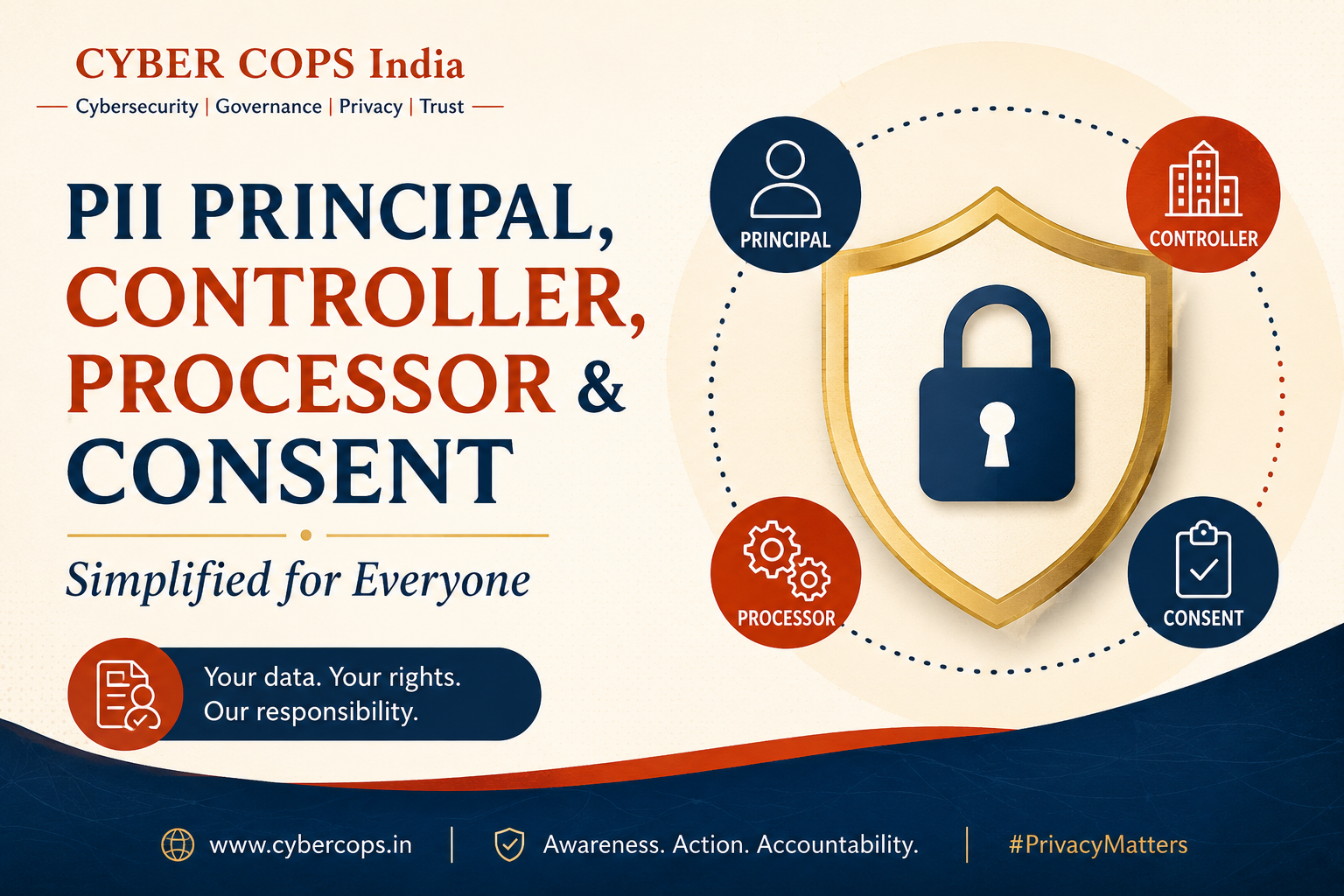
ISO 27701 defines the PII Principal as the natural person to whom the personally identifiable information (PII) relates. The DPDP Act 2023 uses the equivalent term Data Principal — the individual whose personal data is being collected or processed, and who holds specific statutory rights: access, correction, erasure, grievance redressal, and the right to nominate someone to exercise these rights after death or incapacity.
You are the PII Principal every time you fill a job application, submit KYC at a bank, or check into a hospital. Think of your personal data as your personal diary — it’s about you, it belongs conceptually to your life story, and nobody has the right to read it, copy pages out of it, or hand it to a stranger without asking you first.
3PII Controller / Data Fiduciary
ISO 27701 calls this the PII Controller — the entity that, alone or jointly with others, determines the purposes and means of processing PII. The DPDP Act 2023 calls the same role the Data Fiduciary — the person or organisation that alone, or in conjunction with others, determines the purpose and means of processing personal data, and carries the primary legal accountability: obtaining valid consent, implementing “reasonable security safeguards,” notifying breaches, and answering to the Data Protection Board.
Picture a bank locker. You (the Principal) place your jewellery — your data — inside it. But it’s the bank manager (Controller/Fiduciary) who decides the locker room’s rules: who’s allowed in, which security vendor to hire, what happens if there’s a break-in, and who gets called first if something goes missing. The bank doesn’t own your jewellery, but it is squarely responsible for how safely it’s kept.
4PII Processor / Data Processor
ISO 27701 defines the PII Processor as an entity that processes PII on behalf of, and strictly according to the instructions of, a PII Controller — with no independent purpose of its own for that data. The DPDP Act 2023 mirrors this with Data Processor: an entity that processes personal data on behalf of a Data Fiduciary under a valid contract. The Processor generally has no direct obligation toward the Data Principal; accountability continues to sit with the Fiduciary, even though the Processor is contractually bound to follow instructions and safeguards.
Continuing the locker analogy — the bank hires a private security agency to guard the locker room. The agency doesn’t set policy; it just executes instructions: “verify ID cards, log every entry, lock up by 6 PM.” If something goes wrong, it’s the bank (Fiduciary) that answers to you first — though the agency (Processor) is still on the hook contractually for following the SOPs it was given.
5Processing
ISO 27701 (aligned with ISO/IEC 29100) defines processing as any operation performed on PII — collection, recording, organisation, structuring, storage, adaptation, retrieval, consultation, use, disclosure, combination, restriction, erasure, or destruction. The DPDP Act 2023 defines it almost identically: “any wholly or partly automated operation or set of operations performed on digital personal data,” covering the same lifecycle from collection through to erasure.
Processing is every single step in a recipe — buying the ingredient, storing it in the fridge, chopping it, cooking it, plating it, and eventually throwing away the leftovers. Each of those steps, individually, counts as “processing” the ingredient. In the same way, collecting your phone number, storing it in a CRM, using it for a marketing SMS, and finally deleting it after the retention period — all of it is “processing,” not just the moment of collection.
6Consent
The DPDP Act 2023 requires consent to be free, specific, informed, unconditional, and unambiguous, given through a clear affirmative action, accompanied by a notice describing the personal data collected and the purpose of processing. Pre-ticked boxes or bundled consent are not valid. ISO 27701 similarly requires organisations to maintain documented mechanisms for capturing, recording, and — critically — withdrawing consent, with withdrawal being as easy as giving it.
Consent is like a restaurant asking, “Can we put your photo up on our new menu board?” — and you actually ticking a box yourself, rather than finding it pre-ticked when you weren’t looking. And just as you should still get served your food even if you say no to the photo, withdrawing consent for a non-essential use shouldn’t mean the core service is denied to you.
7Consent Manager
The Consent Manager is a concept unique to the DPDP Act — a registered, interoperable platform through which a Data Principal can give, review, manage, and withdraw consent across multiple Data Fiduciaries from a single interface. It must be registered with the Data Protection Board and act accountable to the Data Principal, not to the Fiduciaries it interfaces with.
Think of it as a universal remote control for all your data-sharing switches. Instead of separately calling your bank, insurer, and telecom provider every time you want to change a permission, you flip the relevant switches from one dashboard — and it talks to everyone on your behalf.
8Significant Data Fiduciary (SDF)
The Central Government may notify certain Data Fiduciaries as Significant Data Fiduciaries based on factors such as the volume and sensitivity of personal data processed, risk to the rights of Data Principals, potential impact on the sovereignty and integrity of India, and risk to electoral democracy or public order. SDFs carry enhanced obligations: appointing a Data Protection Officer based in India, conducting Data Protection Impact Assessments, and undergoing periodic independent audits.
It’s the difference between your neighbourhood chemist and a large hospital chain. Both handle your health information, but the hospital chain — because of the sheer scale and sensitivity of what it holds — needs a dedicated compliance department, regular external audits, and a senior in-house doctor (the DPO) permanently stationed on-site, in a way the small chemist simply doesn’t need to.
9Personal Data Breach
The DPDP Act 2023 defines a personal data breach as any unauthorised processing of personal data, or any accidental disclosure, acquisition, sharing, use, alteration, destruction, or loss of access to personal data, that compromises its confidentiality, integrity, or availability. On occurrence, the Data Fiduciary must notify both the Data Protection Board and the affected Data Principals. ISO 27701:2025 — now a stand-alone standard rather than an ISO 27001 extension — carries its own incident management and communication requirements for privacy breaches, while remaining aligned with ISO 27001:2022 for organisations running an integrated ISMS + PIMS.
It’s like your house keys ending up with the wrong person — whether someone broke the lock and rearranged your furniture, or you accidentally left a spare key with the wrong neighbour, or the lock itself just failed and anyone could walk in. Intentional theft or an honest slip-up, it’s still a breach either way — and just as you’d tell your housing society watchman and your family immediately, the Fiduciary must tell the regulator and you.
“Behind almost every dense compliance term is a situation you’ve already lived through — a locker, a diary, a restaurant menu, a spare house key. Once you find that everyday picture, the technical definition stops being something you memorise and starts being something you simply recognise.”
10How It All Connects
Reading each term on its own is useful, but audit evidence rarely arrives one term at a time — a consent-withdrawal ticket, a processor contract, and a breach notification can all touch the same data flow within a single control test. The flowchart below lays out who instructs whom, where consent sits in the chain, and the two branch points every GRC practitioner should be watching: does this Fiduciary cross the Significant Data Fiduciary threshold, and did something go wrong during processing.
Two things stand out once the roles are laid out this way. First, consent is the only thing that flows directly from the Principal — everything downstream (processing, sub-contracting, breach notification) is the Fiduciary’s responsibility to manage and account for, even when a Processor is doing the actual work. Second, the two diamonds are where most audit findings originate: an SDF-threshold assessment that was never revisited as data volumes grew, or a breach-notification clock that started ticking before anyone in the room realised it.
11Quick Reference Table
For quick recall during audits, workshops, or policy reviews — the whole set, side by side.
| ISO 27701 Term | DPDP Act 2023 Term | Everyday Picture |
|---|---|---|
| PII Principal | Data Principal | You — the diary owner |
| PII Controller | Data Fiduciary | The bank manager who sets locker rules |
| PII Processor | Data Processor | The security agency following instructions |
| Processing | Processing | Every step in a recipe, start to finish |
| Consent | Consent | Genuinely ticking the photo-permission box |
| — | Consent Manager | A universal remote for data permissions |
| — | Significant Data Fiduciary | The hospital chain vs. the neighbourhood chemist |
| Incident (ISO 27001-aligned) | Personal Data Breach | Your house keys in the wrong hands |
A Note for Fellow GRC Practitioners
When you’re mapping ISO 27701 controls to DPDP Act obligations during an integrated audit — say, for a controller-processor contract review or a consent-workflow evidence check — it helps to explain these terms to business stakeholders using the everyday picture first, and the formal definition second. It lowers resistance in interviews and produces far more honest, complete answers than leading with the statute language.