ISO 19011:2026 Decoded: The Auditor’s Craft of Learning, Unlearning and Relearning
 CYBER COPS India
Researching Bits & Bytes for a safer cyberspace
CYBER COPS India
Researching Bits & Bytes for a safer cyberspace
GRC & Audit
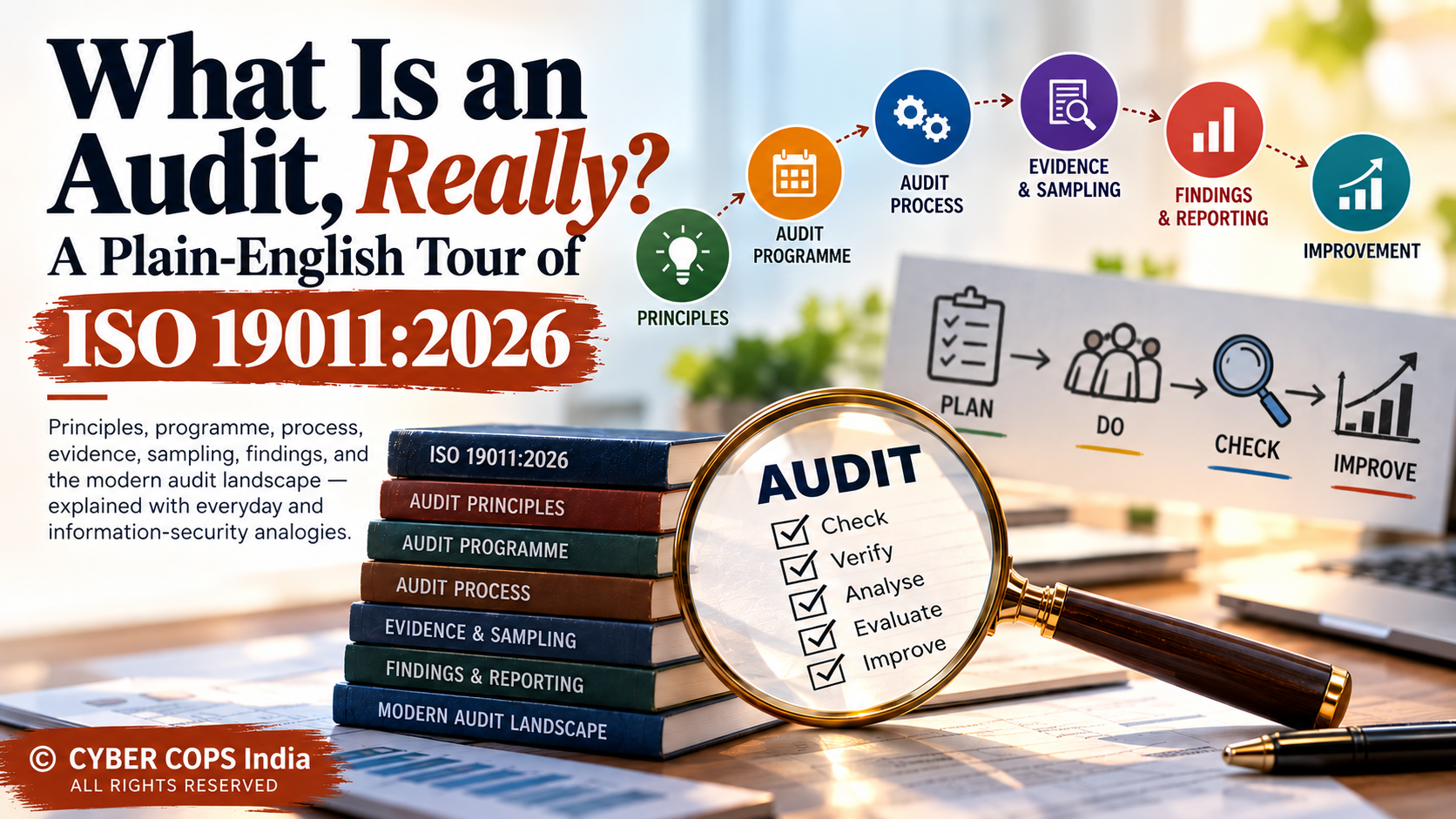
What Is an Audit, Really? A Plain-English Tour of ISO 19011:2026
No jargon, no fear. The principles, the programme, the process, the evidence, the findings and the mindset, explained the way you’d explain them to a friend over chai.

Why the Word “Audit” Makes People Nervous
And why it really shouldn’t
Say the word “audit” in a room full of people and watch the temperature drop. Chairs shift. Someone remembers an email they forgot to send. People start hunting for the latest version of the policy, someone checks whether the evidence folder is complete, and a voice announces, “the auditor is coming next week, we need to get everything ready.” It’s treated like a fire drill: something to survive, not something to understand.
That reaction tells you how audits are usually misunderstood. A good audit is not a hunt for mistakes. It is not an interrogation, not a documentation competition, and it should never be a game of “let’s see what we can catch them doing wrong.” At its heart, an audit asks one simple question:
Strip away the paperwork and an audit is one of the most familiar things in your life. You’ve been auditing since childhood. You just never called it that.
Here’s the part most people never say out loud: nobody ever finishes learning how to audit. Not the intern shadowing their first walkthrough, not the auditor with a decade of ISO 27001 certifications behind them, not the veteran who’s heard every excuse in the book. The moment an auditor decides they’ve “arrived,” their judgement starts going stale, because the risks, the technology and the standard itself keep moving. The only real expert is the one who keeps unlearning yesterday’s habits and relearning today’s better ones. This article is written with that in mind, for whichever stage you’re at.
You’ll get the mental model first: what an audit actually is, before any checklist, so the terminology stops feeling like a foreign language.
You’ll get the craft: sampling judgement, finding construction, the “trust me” versus “show me” reflex. The stuff that separates a checklist-filler from a real auditor.
You’ll get what changed in the 2026 edition, checked against ISO and CQI/IRCA sources, and a reason to keep questioning your own habits.
ISO 19011 is simply the world’s shared instruction manual for doing that “planned, honest look” properly, whether the thing being checked is a car, a hospital, a bank’s data centre or your organisation’s information security programme.
What an Audit Really Is
Start with a kitchen, not a standard
Imagine you hire a contractor to renovate your kitchen. You agree on the tiles, the wiring, the plumbing, the cabinet sizes and the finish date. One evening the contractor says, “The kitchen is complete.” Do you reply, “Great, I trust you”?
Almost certainly not. You walk in, look at the tiles, open the cabinets, run the taps and test the sockets, and you compare what you see with what was agreed. That walk-through is an audit.
Notice what the walk-through is not. You are not asking whether a plan exists, and you are not hunting for someone to blame. You are asking a better question: what requirement applies, what was set up to meet it, what is actually happening, and what evidence shows it? That one change in wording is the difference between a policy check and a real audit.
ISO 19011 has long framed an audit as a systematic, independent and documented process for gathering and objectively evaluating evidence. Each of those three words is doing real work:
There is a planned method, not a wander around the building. Someone else could repeat it and get a comparable result.
The auditor is free enough from conflicts that the conclusion can be trusted. Where full independence isn’t possible, bias must be actively managed.
The work leaves a trail: scope, evidence, findings. Anyone reviewing the audit can follow it and challenge it.
Audit, inspection, investigation: three words people use interchangeably
They shouldn’t be. Each asks a different question, and confusing them is how audits quietly turn into witch hunts.
| Activity | The question it is really asking |
|---|---|
| Audit | Are defined criteria being fulfilled, based on objective evidence? |
| Inspection | Is this particular item, activity or condition acceptable right now? |
| Investigation | What happened, and why did it happen? |
| Assessment | How capable, suitable or effective is something? |
| Certification audit | Does the management system conform sufficiently to the certification requirements? |
Where ISO 19011 Fits
The “how” behind every management system audit
ISO 19011, titled “Guidelines for auditing management systems,” is a guidance standard, not a requirements standard. That distinction matters:
- You cannot be “certified to” ISO 19011. There is no certificate to frame on the wall.
- It does not tell you what to audit against. That is the job of the management system standard in question: ISO/IEC 27001, ISO 22301, ISO 9001, ISO 42001 and so on.
- It tells you how to audit: the principles, the planning, the process and the people skills that make an audit trustworthy.
One method, three kinds of audit
The same guidance applies whoever is sitting in the auditor’s chair:
Internal audit
An organisation audits itself, to find and fix problems before anyone else does.
Customer or supplier audit
A customer audits its supplier, or an organisation audits a provider in its supply chain.
Independent or certification audit
An external body audits against a standard’s requirements, as in certification or regulatory audits.
The standard is organised into four practical blocks. The rest of this article walks through each one, in the order you’d meet them in real life:
Principles of auditing
The ethics that make an audit worth trusting. See section 04.
Managing an audit programme
The yearly rhythm of audits across an organisation. See section 05.
Conducting an audit
The step-by-step life of a single audit. See sections 06 to 10.
Auditor competence
What actually makes someone good at this job. See section 12.
The Seven Principles: Where Trust Comes From
Before any checklist, there is character
Here is a thought experiment. Two auditors review the same access-control process. One is rushed, friendly with the process owner, and writes what the manager tells them. The other is careful, impartial and asks to see the logs. Both fill in the same template. Only one of the two reports deserves to be believed.
ISO 19011 knows this, so before it describes a single procedure it describes principles. They are the difference between an audit that merely exists and an audit that can be trusted. Think of them as the seven habits that keep human bias out of the room.
The foundation of professionalism
Be honest, diligent and responsible. Respect the law. Declare any conflict of interest. Like a referee who calls the foul even against the home team.
Report truthfully and accurately
Findings, conclusions and reports reflect the audit honestly, including disagreements and obstacles met on the way. Like a match report that mentions the missed goal as well as the winning one.
Diligence and good judgement
Apply care in proportion to the importance of the task, and use judgement you can defend. Like a surgeon who counts the instruments twice.
Security of information
Handle sensitive information with discretion; never use it for personal gain. Like a doctor, a lawyer or a bank manager. In InfoSec, auditors often see the crown jewels, so this one is not optional.
The basis for impartiality and objectivity
Stay free of bias and conflicts of interest wherever practicable, and manage it openly where you cannot. Like a judge who recuses herself from a family case.
The rational basis for reliable conclusions
Conclusions rest on verifiable evidence, gathered by sampling with judgement. Like a court: “I heard he was there” is not testimony.
Focus on what matters most
Direct audit effort to the areas of greater risk and significance to the organisation. Like a security guard who spends more time at the vault than at the car park. In the 2026 edition, CQI/IRCA notes that this principle is applied at the level of the audit programme as well.
The Audit Programme: The Year, Not the Day
One audit is an event. A programme is a system.
Most people picture an audit as a single visit: the auditor arrives, asks questions, leaves. But an organisation rarely runs just one audit. It runs a set of audits over a period of time, aimed at a specific purpose, and the thing that organises them is called the audit programme.
What the programme has to settle
- Objectives: why does the programme exist? Certification readiness, regulatory comfort, supplier assurance, continual improvement?
- Risks and opportunities: what could stop the programme from delivering, and where could it add extra value?
- Extent: how many audits, of what scope, how often, in which locations or functions?
- Resources: auditors with the right competence, time, budget and tools.
- Procedures: how audits will be scheduled, conducted, reported and followed up.
- Records and review: how results are kept, and how the programme itself is monitored and improved.
The programme follows the familiar Plan, Do, Check, Act cycle, and the last step feeds the first. The findings of this year’s audits shape the shape of next year’s programme: areas that keep failing get more attention, areas that keep passing may get less.
The Audit Journey: Six Steps From Idea to Improvement
Every audit follows the same arc
Whether you audit a bakery, a hospital or a data centre, a single audit moves through the same stages. ISO 19011 describes them as initiating, preparing, conducting, reporting, completing and following up. Here is the same journey in a form you can pin to the wall.

- Initiate the auditConfirm the audit’s objectives, scope and criteria, agree who leads, and make first contact with the auditee. Check the audit is feasible. “Is this trip possible, and where are we going?”
- Prepare the audit activitiesReview the documents, build the audit plan, assign the team, prepare working papers and sampling ideas. “Packing, maps and a plan for the day.”
- Conduct the auditHold the opening meeting, communicate during the audit, collect and verify information, form findings and conclusions, and hold the closing meeting. “The actual journey.”
- Prepare and distribute the reportPut the findings and conclusions into a complete, accurate, clear and timely report for the audit client. “The trip diary that someone else can read.”
- Complete the auditConfirm that the planned activities were carried out, then close out records and handle confidentiality of the documents. “Unpack, file the receipts.”
- Conduct audit follow-upWhere the audit calls for it, verify that corrections and corrective actions were done and worked. “Did the car actually get fixed?”
Objective, Scope and Criteria: The Three Anchors
An audit without these three wanders
Before an auditor opens a single file, three questions must have clear answers. Skip any one of them and you get an audit that wanders, produces findings nobody agrees with, or quietly turns into a different audit than the one the client wanted.
Why are we auditing?
The purpose: to check readiness for certification, verify a supplier, confirm a corrective action worked, test an ISMS against 27001.
Where are we looking?
The extent and boundaries: which locations, functions, processes, systems and time period are included, and which are not.
What do we compare against?
The yardstick: policies, procedures, contracts, laws, and the requirements of the relevant standard, such as ISO/IEC 27001.
Auditor, auditee, audit client: who is who
| Role | Who they are | Everyday picture |
|---|---|---|
| Audit client | The person or body that requests the audit | The family that books the home inspection |
| Auditee | The organisation or part of it being audited | The house being inspected |
| Auditor | The person who conducts the audit | The inspector |
| Audit team leader | Leads the team and is accountable for the audit | The senior inspector |
| Technical expert | Provides specific knowledge to the team, but does not audit | The electrician called in to read the wiring |
| Guide | Appointed by the auditee to help the team find its way around | The caretaker who knows where the keys are |
Evidence and Sampling: “Trust Me” Versus “Show Me”
The heart of the craft
If you remember only one sentence from this article, make it this one: a statement is not evidence until it has been verified. “We review access every quarter” is a claim. The signed review record, the list of users it covered and the tickets raised for the removals it caused are evidence.
ISO 19011 separates two things that beginners often blur together. Audit evidence is the records, statements of fact and other information relevant to the criteria and verifiable. Audit findings are the results of evaluating that evidence against the criteria. Evidence goes in; findings come out.
“Yes, we remove leavers’ access on their last day. It’s our process.”
“Please show me the five most recent leavers, their last working day, and the timestamp when each account was disabled.”
Four ways to collect evidence
Talk to the people who do the work. They tell you what really happens, and where the process bends.
Watch the activity being performed. People behave differently from how they describe their behaviour.
Policies, procedures, contracts, tickets, minutes. They show what was intended and what was recorded.
Logs, configurations, reports, screenshots taken live. They show what the system actually did.
The best conclusions triangulate: interviews, observation, documents and system records all point in the same direction. When they disagree, you have not found a finding yet. You have found a place to dig.
The three-layer test: defined, done, delivering
A very common weakness in audits is stopping at “the document exists”. A stronger audit asks three questions in ascending order.
Sampling: you cannot check everything
Auditors rarely have the time to examine every record, so they examine a sample and draw conclusions about the whole. Done well, sampling is a science. Done by habit, it is a ritual.
- Be representative. Cover different teams, shifts, locations, time periods and people, not just the ones the auditee suggests.
- Be risk-aware. Look harder at privileged accounts, critical suppliers and high-impact changes than at routine, low-risk items.
- Be honest about limits. A sample supports a conclusion with some uncertainty. Say so in the report.
- Let evidence move you. If the first three records reveal a weakness, expand the sample instead of sticking to “five, always five”.
Questions that open doors
Good auditors ask open questions, then follow the thread. A few that never go out of style:
“Walk me through what happens when a new joiner needs access.”
“Tell me about the last time this did not go to plan.”
“Can you show me where that is recorded?”
“Who is responsible for this, and who covers when they are away?”
“How do you know it is working? What do you look at?”
“What changed after the last incident or audit?”
Audit Findings: Turning Evidence Into Something Useful
A finding is not a feeling
After the evidence is gathered, the auditor evaluates it against the criteria. The results are audit findings. Findings can show conformity, indicate nonconformity, or point to an opportunity for improvement.
It meets the requirement
Worth recording. Good practice and strengths are findings too, and they tell the organisation what to protect.
It does not meet the requirement
Evidence shows a requirement is not fulfilled. This is the finding that demands correction and corrective action.
It meets it, but could be better
Not a failure. A pointer to something that could work better, and it should not be written up as if it were a nonconformity.
The anatomy of a good nonconformity
“Access management is poor.”
“Requirement A.5.18 and the Access Control Policy section 4.2 require quarterly review of privileged accounts. Records show no review in Q2 or Q3 for 14 of 14 sampled domain admin accounts. The requirement is not met.”
Notice what the strong version does. It names the requirement, states exactly what was seen, and leaves the auditee nothing to argue about except the fact itself. It does not guess at the cause, and it does not prescribe the fix.
Not all findings weigh the same
CQI/IRCA’s summary of the 2026 edition notes that the standard now gives clearer direction on grading nonconformities. Organisations and certification bodies often use major/minor or similar labels, and it helps if the logic is shared. Here is an illustrative way to think about it:
| Level | Typical thinking | Illustration |
|---|---|---|
| Systemic failure | A whole requirement is not fulfilled, or controls fail across the board | No risk assessment has been performed at all |
| Significant | A requirement fails in a material area, with real risk | No access review of privileged accounts for a year |
| Isolated | A single lapse in an otherwise working control | One leaver’s account disabled four days late |
| Observation | Not a failure, but worth attention | The review log is kept in three different formats |
These labels are an illustration, not the standard’s wording. Use the grading scheme that your programme or certification body defines, and apply it consistently.
Reporting and Follow-up: Where Audits Create Value
An audit that changes nothing was just an expensive conversation
Two meetings frame the conduct of an audit. The opening meeting confirms scope, plan, communication channels and ground rules. The closing meeting presents findings and conclusions so the auditee understands them and agrees on timelines. Then comes the report.
An audit report should be complete, accurate, concise, clear and timely. It records the objectives, scope and criteria, the audit team, dates and locations, the findings and the conclusions. It is the audit’s permanent memory, so write it for the person who reads it a year later and was not in the room.
Fixes the immediate problem. “The 14 stale privileged accounts were reviewed and four were disabled today.”
Removes the cause so it does not return. “A quarterly review task with an owner, a calendar reminder and an escalation to the CISO if missed.”
One more thing about follow-up. It is often a separate activity, sometimes by a different auditor, sometimes in the next scheduled audit. What matters is that someone verifies that the action was implemented and that it worked.
An Audit in Action: Tracing One Person Through Access
How an ISMS auditor really thinks
Theory is comfortable; practice is where it earns its keep. Here is a favourite technique of experienced auditors: pick one real person and trace their journey through a process, instead of reading the process in the abstract. Let us follow a new joiner, “Asha”, through user access management.
At each step, the auditor asks a question and asks to see the proof. When was the request raised? Who approved it, and were they entitled to? Did the access provisioned match what was approved? Was the access ever reviewed? And when Asha moves teams or leaves, how quickly did the old rights disappear? A single thread, pulled carefully, tests a dozen controls at once.
Try it yourself: three realistic situations
The manager says “we never allow shared accounts”
Nice to hear. Now ask: how would you know if one existed? Request the user list for the production database, look for generic names such as “admin2” or “support”, and ask who uses them. The claim is the starting point; the list is the evidence.
The policy is excellent but nobody on the floor has heard of it
That is a layer-one pass and a layer-two failure. Ask three staff, from different teams, how they would report a suspected phishing email. If they give three different answers, the awareness requirement is not being implemented, however good the PDF looks.
You find a serious issue on the last afternoon
Raise it immediately with the audit team leader and the auditee, not in the report three weeks later. Verify the facts, give the auditee a chance to respond or correct misunderstandings, and make sure it is discussed at the closing meeting. No surprises.
What Makes a Good Auditor: Skill and Character
Knowledge opens the door; behaviour decides what you find behind it
ISO 19011 treats competence as more than a qualification. It combines knowledge and skills (what you know and can do) with personal behaviour (how you act), and it expects both to be evaluated and developed over time.
Alongside the classics (audit methods, the management system standard, legal requirements, communication skills), the 2026 edition puts weight on technology, information security and data protection knowledge, and on the behaviour of being determined rather than merely tenacious. Persistent, not pushy.
Evaluation matters too. The standard expects auditor performance to be reviewed after audits, and CQI/IRCA highlights that feedback is now part of how auditors are evaluated. The best auditors invite that feedback rather than endure it.
What Changed in ISO 19011:2026NEW
An evolution, not a revolution. But the details matter.
If you learned auditing with the 2018 edition, here is the reassuring news: the foundations are still standing. The principles, the programme, the six-step process and the competence model carry over. CQI/IRCA describes the 2026 edition as a technical revision that clarifies and updates the guidance, and it took effect on publication, with no transition period.
Here is a summary of the changes highlighted by CQI/IRCA and in public commentary. The table is a reading guide, so please confirm exact clause wording against the published standard before quoting it in your own work.
| Area | What to look for in 2026 | Why it matters |
|---|---|---|
| Remote auditing | Clearer terminology for remote audit methods, aligned with ISO/IEC TS 17012:2024 | Remote work is routine; the vocabulary should be consistent between organisations |
| Independence | Reworded guidance on independence of auditors and the audit function | Internal auditors who wear two hats need to be especially careful |
| Risk-based approach | Applied explicitly to the audit programme, not just the individual audit | Programme managers must show why effort goes where it does |
| Nonconformity grading | Clearer direction on how nonconformities are graded | Consistency between auditors and between audits |
| No surprises | Reports should not contain anything not already communicated to the auditee | Protects trust, and forces issues to be raised early |
| Technology and AI | Competence expectations reflect the technology auditors now use and encounter | Auditing AI-enabled processes, and auditing with AI tools, both need judgement |
| Data protection and information security | Auditors are expected to understand these when handling auditee information | Auditors hold sensitive evidence; they must protect it |
| Behaviour | “Determined” replaces “tenacious” among personal attributes | A subtle but telling shift in tone: persistent, not pushy |
| Auditor evaluation | Feedback is part of how auditor performance is evaluated | Auditors are expected to keep improving |
| Supply chain | Updated terminology, including in the annex on auditing supply chains | Third-party risk is now a central audit topic |
What should a seasoned auditor do on Monday morning? Read the new edition end to end, update your audit procedures and templates, brief the team on the changes in reporting and grading, and check whether your auditor evaluation process collects feedback. That is the unlearning and relearning in practice.
Auditing in a Modern World: Remote, Combined, Continuous
The same principles, new rooms
Remote auditing
Video interviews, screen-shared evidence and virtual walkthroughs are now an ordinary method, not a workaround. The trade-offs: confidentiality, evidence integrity and identity verification all deserve deliberate thought when you are not in the room. Ask for live screen sharing, not yesterday’s screenshots.
Combined and joint audits
One organisation, several management systems (ISO 27001, ISO 22301, ISO 9001) audited in a single visit. Like one full health check instead of four separate appointments, but each system still needs its own criteria and its own conclusion.
Technology-assisted evidence
Data analytics, system-generated reports and automated evidence collection let auditors test whole populations instead of samples. Powerful, but the auditor remains responsible for understanding where the data came from and whether it is complete.
Auditing AI-enabled processes
When a process includes an AI model, the criteria might come from ISO/IEC 42001 and internal policies. The audit questions stay familiar: who is accountable, what is the data, how is it monitored, what happens when it goes wrong?
Seven Mistakes Even Good Auditors Make
Recognise them in yourself first
- 1Auditing the document instead of the processA beautiful 25-page procedure proves management wrote something down. It proves nothing about whether it is followed.
- 2Accepting “yes” as evidenceA manager’s verbal confirmation is a starting point for verification, not the end of it.
- 3Treating every finding as equally seriousA missing signature and a missing access review are not the same magnitude of risk. Say so.
- 4Turning into an investigator mid-auditNot every anomaly needs a forensic deep-dive. Know when to note it and move on, and when to escalate.
- 5Quietly becoming the consultantExplaining the gap is the job. Designing the auditee’s fix for them blurs a line that protects your independence.
- 6Sampling on autopilot“Five records, always five records” is not a methodology. It is a habit that stopped being examined.
- 7Making it personalThe finding is about the process, never the person defending it. Lose that distinction and cooperation disappears.
The Expert Auditor Never Stops Unlearning
Why this profession has no finish line
There is a quiet trap in auditing. The more audits you complete, the more patterns you recognise, and the faster you reach conclusions. Speed feels like expertise. But speed built on yesterday’s patterns is how experienced auditors miss today’s risks: the cloud service nobody listed, the AI tool a team adopted last month, the supplier that quietly changed its subcontractor.
That is why the best auditors treat their own knowledge the way they treat an auditee’s claims: useful, but subject to verification. They unlearn what no longer holds, learn what has changed, apply it, and reflect on what happened. Then they do it again.
Be curious without fear. Ask “why” until the answer is evidence. Shadow different auditors and borrow their best habits. Your fresh eyes are an asset; do not rush to lose them.
Audit your own audits. Which findings did the auditee dispute, and were they right? Read the standards you only know through templates. Learn one adjacent field, such as cloud, privacy or AI governance.
Mentor, and let yourself be challenged by those you mentor. Re-read the basics with fresh eyes each time a standard is revised. Seniority is a reason to ask more questions, not fewer.
The Whole Standard on One Page
A mind map and a pocket checklist
Before the audit
During the audit
After the audit
Key Takeaways
If you only remember eight things
- ✓ISO 19011:2026 is a “how”, not a “what”. It teaches the method of auditing, not a specific set of controls, and it works alongside ISO/IEC 27001, 22301, 9001 and others.
- ✓The 2026 edition is an evolution. Expect clearer terminology, risk-based thinking at programme level, better direction on grading and reporting, and stronger expectations on technology and feedback.
- ✓Get objective, scope and criteria straight first. An audit without all three wanders and produces findings nobody agrees with.
- ✓Seven principles keep an audit honest: integrity, fair presentation, due professional care, confidentiality, independence, evidence and risk.
- ✓A statement is not evidence. Triangulate interviews, observation, documents and system records, and sample with judgement, not habit.
- ✓A finding is requirement plus evidence plus evaluation. It is not the root cause, and correction is not corrective action.
- ✓Skill and character both count. Technical knowledge earns access to the data; personal integrity earns access to the truth.
- ✓Never stop unlearning. The expert auditor is the one who keeps upgrading, one audit and one revision at a time.
Sources and further reading
- ISO 19011:2026, Guidelines for auditing management systems, 4th edition, published May 2026 by the International Organization for Standardization.
- CQI and IRCA, summary of the changes in ISO 19011:2026 for auditors and training providers.
- ISO/IEC TS 17012:2024, Conformity assessment: Guidelines for the use of remote auditing methods.
- ISO/IEC 27001:2022, Information security management systems: Requirements.